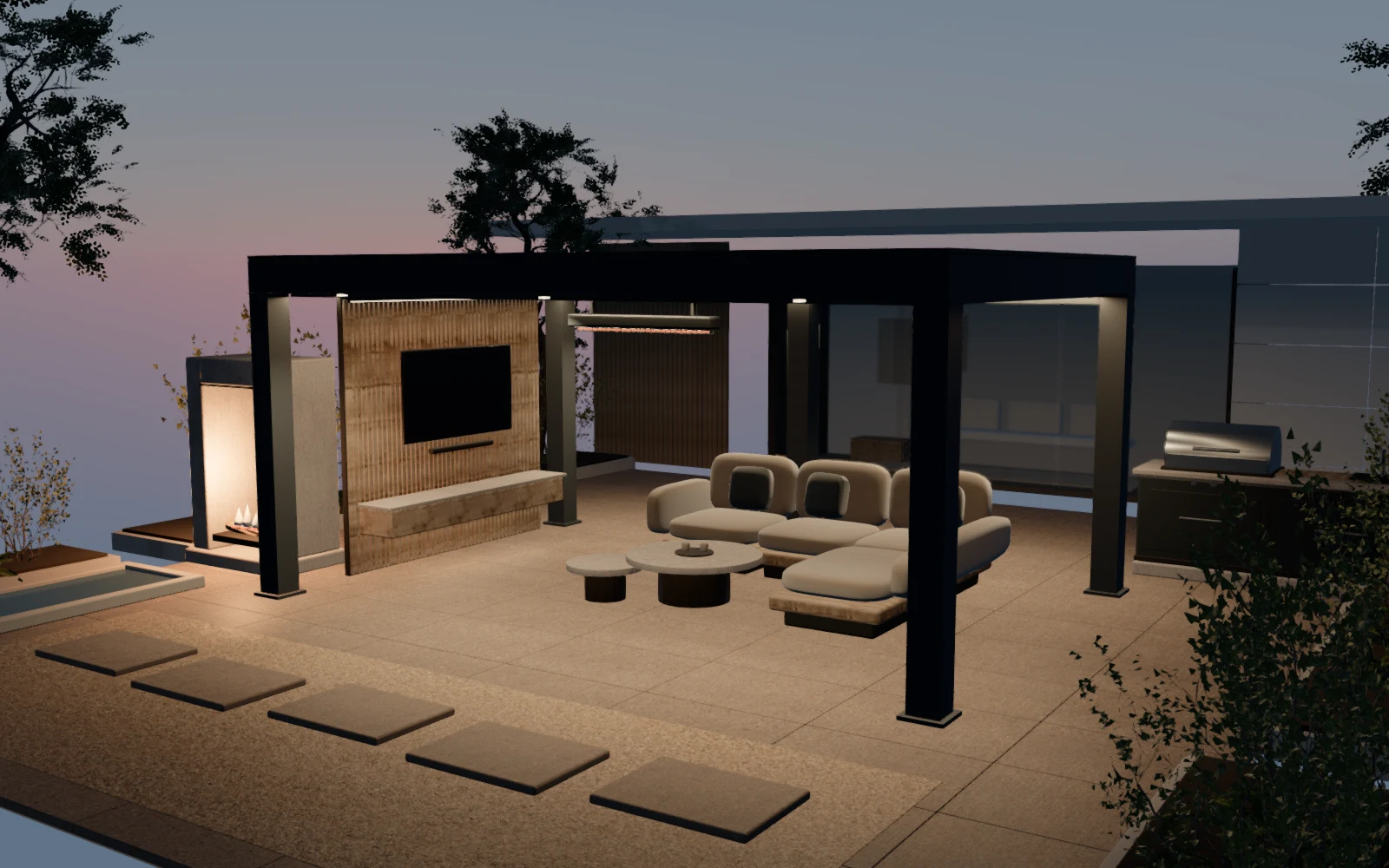
390 px: louvres opened
A retained 3D image after the opening-angle action at the mobile-width viewport.
Open the 390 px imageSee how size, glass, light and view controls changed the public 3D demo in one dated mobile and desktop test.
When someone changes a product option, they need to see the expected result before deciding what to ask for. VURM ran its own developer test of the live public 3D configurator on 6 November 2026. In fresh browser contexts at 390 px and 1440 px wide, we performed the same 15 UI actions in each view: size, louvres, front glass, finish, lighting, scene appearance, undo, redo and zoom. That made 30 recorded actions in one test.
Every recorded action passed. The recorded state and 3D image both changed as expected: the test recorded 42 rotating louvres, five front-glass panes and five sliding panes where those controls applied. Dimensions and the example price changed for the width and depth actions. This is a developer observation of this public demo, not a customer result.
For a product configurator, a useful question is whether a visible control produces the state a visitor expects. Here, opening the louvres changed the recorded angle to 90 degrees; adding, sliding and removing front glass changed the matching scene objects; finish, evening mode, LED, studio appearance, undo, redo and zoom each changed the recorded state. The stored before-and-after images make those individual states inspectable.
The test script opened the actual public page with a fresh isolated browser context for each viewport and compared the rendered 3D image with relevant geometry, light and camera states. It used Chromium 151.0.7922.34 on a Linux x64 shared host with software GPU. It submitted no quote, sent no email and requested no camera permission. Images were taken outside the recorded interaction timing.
This is one controlled developer test, not a population sample or independent certification. Automation and frame scheduling are included in the timing, so it is not an INP or pure GPU measurement. It does not establish physical AR placement, phone or GPU performance, FPS, loading speed, responsiveness or visual stability for real visitors, accessibility beyond these interactions, conversion, enquiries or sales.
Some roof edges show aliasing in the retained images. We therefore make no claim about photorealism or general visual quality. The test report, 60 retained images, test script and hashes of the script plus the three public engine files are available below so the observation can be checked or repeated.
A retained 3D image after the opening-angle action at the mobile-width viewport.
Open the 390 px imageThe corresponding 3D image at desktop width after the same action.
Open the 1440 px imageAll actions, recorded states, image hashes, test-script hash and public engine hashes from the completed test.
Download the JSON reportRun in a new empty output directory: node assets/research/verify-configurator-practice.mjs <new-output-directory>.
Open the test scriptWe opened the public demo twelve times: three new browser contexts, each followed by an immediate reload, at both 390 and 1440 pixel widths. We kept the authored luxury view. This is a separate startup observation, not a replacement for the 6 November interaction test.
Eleven attempts produced both timings. One fresh-context attempt at 1440 px timed out during the browser measurement despite HTTP 200 and no recorded JavaScript error. The collector did not record the precise timeout step. That attempt remains missing timing evidence; it is neither counted as zero nor attributed to a website defect.
390 px, fresh browser context: 3 of 3 attempts observed. Controls ready: median 1.60 s (0.95–2.33 s). Large luxury model ready: median 29.34 s (25.12–30.85 s). Parentheses show the observed minimum and maximum.
390 px, immediate reload: 3 of 3 attempts observed. Controls ready: median 2.20 s (1.83–4.15 s). Large luxury model ready: median 30.01 s (24.39–31.12 s). Parentheses show the observed minimum and maximum.
1440 px, fresh browser context: 2 of 3 attempts observed. Controls ready: median 1.50 s (1.27–1.73 s). Large luxury model ready: median 26.47 s (26.40–26.53 s). Parentheses show the observed minimum and maximum.
1440 px, immediate reload: 3 of 3 attempts observed. Controls ready: median 1.81 s (0.80–2.51 s). Large luxury model ready: median 26.81 s (25.63–31.76 s). Parentheses show the observed minimum and maximum.
Both timings start at page navigation. We observe the actual configurator marking its canvas ready, then check the large luxury asset status every 100 milliseconds. Asset readiness is not proof that every texture or GPU operation has completed. The script scrolls the canvas into view after DOMContentLoaded, so it measures the visible demo.
A visitor may see controls while larger models are still loading. Reloading does not necessarily remove that wait: processing a model and assembling a scene also take time. This test does not fully separate those causes, so we do not attribute every difference to the network or browser cache.
Chromium 151.0.7922.34, Linux on AMD EPYC-Genoa Processor, shared host, software graphics, no artificial CPU or network throttling. Screen widths do not emulate real phones. DNS, operating-system and CDN caches were not flushed; a fresh context and an immediate reload are test conditions, not guaranteed cold or warm caches. Three repeats per condition do not establish typical visitor performance.
The product started at 600 × 400 × 280 cm. Quality was set to automatic; all eleven complete observations reported the effective Light quality level. The luxury product setup is separate from graphics quality. These are not High-quality mode measurements.
Engine hashes matched before and after the study. No forms were sent and no cameras were opened. These observations do not establish speed on consumer devices, smooth animation, quick input responses or stable page layouts for real visitors. They also do not establish physical AR or improvement over an earlier version.
Repeat from the VURM source tree with Node.js 24 and Playwright 1.62.1: node assets/research/measure-configurator-startup.mjs <new-output-directory>. Failed observations remain in the report and existing output directories are not overwritten. Screenshots are taken after the timed observation.
All attempts, resource timings, hardware, browser version and image hashes. Our own lab observation, not a device benchmark.
Download the startup reportA fixed public target with no login, camera access or form submission.
Read the startup collectorA follow-up developer test isolated one cause of long scene assembly on our lab machine: temporary shader programs created while luxury models and their local lights became available one by one. The change keeps three optional local lights out of those intermediate variants, then enables the final configured lighting together after the requested luxury assets settle. Product options, high drawing resolution and the final image remain in place.
We compared five fresh Chromium processes before and after, each followed by a second mount in the same browser context. For the complete luxury configuration at a 960 by 600 drawing buffer, fresh-process complete-model time was 27.39 s mean; 27.43 s median; 26.06–28.93 s range before and 25.30 s mean; 25.28 s median; 23.85–26.41 s range after. First-frame mean changed from 4.04 to 3.78 seconds; it did not become slower in these runs.
The same-context second mounts changed from 30.38 s mean; 30.17 s median; 28.48–31.81 s range before to 28.49 s mean; 28.59 s median; 26.94–29.47 s range after. Software-GPU fenced frame measurements did not improve in every condition, so this does not support an FPS or general rendering-speed claim. The retained settled images had identical SHA-256 values and zero changed RGB channels across 960 by 600 pixels.
The test used Chromium ANGLE with SwiftShader on a shared Linux AMD EPYC-Genoa host. SwiftShader performs graphics work on the CPU. Five samples per condition do not establish desktop-GPU, phone, visitor or field performance; host scheduling and local asset completion order remain sources of variation.
Mean, median, range, shader program counts, method, source hashes and software-GPU limitations.
Download the renderer startup reportAll five cold and five same-context observations, including the configuration and individual timings.
Download the original observationsThe corresponding observations after changing light activation. The current collector adds output-safety guards without changing the measurement steps.
Download the follow-up observationsThe before and after PNG files have identical hashes; one copy is provided here. File hashes are retained in evidence-manifest.json beside the report.
View the captured browser frameVURM can discuss a scoped 3D configurator after the product, options and decision path are clear.
Discuss a 3D configuratorReply from info@vurm.nl